Foreign material contamination is one of those food manufacturing risks that never really goes away.
Equipment wears, components break down, product formulations get more complex…and QA teams are expected to catch it all.
Metal detection and traditional X-ray inspection have come a long way. In many facilities, they’re doing exactly what they’re designed to do. But as products become more layered, more varied, and more complex, inspection challenges evolve too. That’s where new technologies such as CT inspection starts to play a meaningful role.
Why Complex Food Products Are Harder to Inspect
Most inline X-ray inspection systems create a two-dimensional image. As product passes through the beam, the system reads density across the entire path and builds a composite image from that data.
For simple, uniform products, this works well. Dense materials like stainless steel, glass, or stone stand out against a consistent background. But once you introduce natural product variation—shredded cheese, sausage crumbles, frozen entrées, multi-pack cartons, bulk cases—things get more complicated.
We call it “the product layering effect”: layers overlap, edges stack, and density builds on itself.
It’s not that 2D X-ray inspection systems stop working. It’s that, in certain products, identifying low-density contaminants without increasing false rejects becomes much harder. If you’re responsible for food safety and release decisions, you know that tension well.
A material may be labeled “X-ray detectable,” but true detectability depends on the product matrix. A gasket visible in butter may be difficult to identify in a layered frozen entrée. The product environment determines contrast and visibility.
What CT Inspection Does Differently Than X-Ray Inspection
Computed tomography (CT) changes the way the image is built.
Instead of creating one averaged image, CT rotates a gantry around the product and reconstructs it into individual slices—often as thin as half a millimeter. Those slices can then be evaluated across multiple planes, effectively creating a 3D reconstruction of the product.
The practical impact is simple: you remove the layering problem from the equation. By isolating individual slices instead of averaging everything together, CT inspection can improve detection of:
- Glass
- Bone
- Stone
- Ceramic
- Rubber gasket material
- Plastics
- Aluminum fragments
- Small metal shavings
In products with high contrast variation (think pet food kibble, layered burritos, bulk case meats and more), this difference can be significant. It’s not about replacing traditional X-ray—it’s about adding another level of visibility when complexity increases.
Learn More About Our CT Inspection Services
How CT Performs in the Real World
In real-world applications, CT inspection has been particularly helpful in complex product environments.
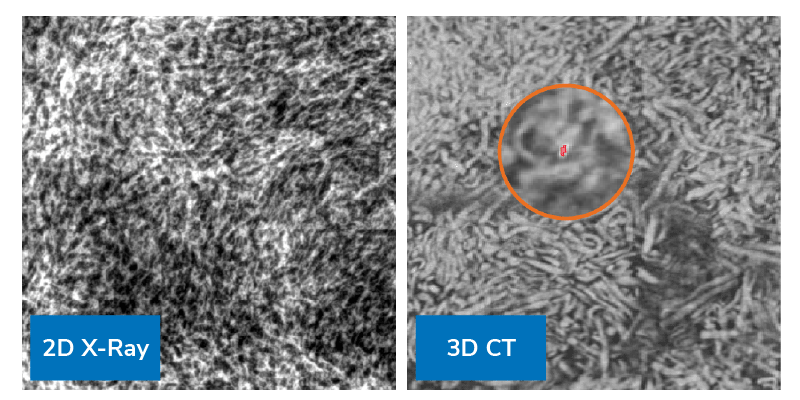
Example #1: Shredded Cheese
Why It’s Difficult with 2D X-Ray:
The sheer number of edges and contrast points creates a noisy image.
How CT Helps:
Peels back the layers and isolate small wire fragments from sifter screens that would otherwise blend into the background.
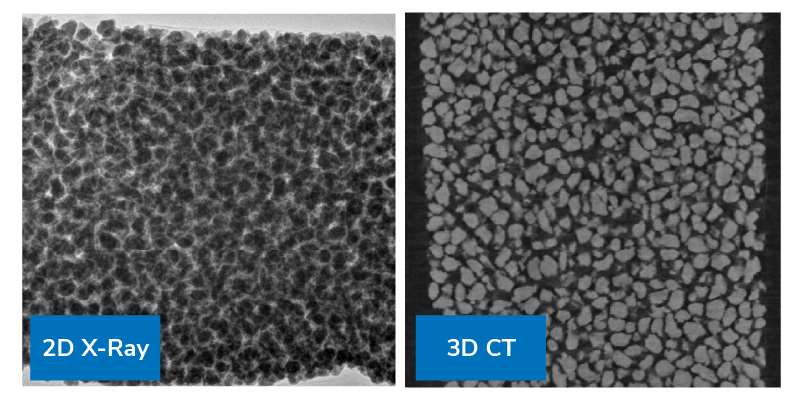
Example #2: Bulk Sausage Crumbles
Why It’s Difficult with 2D X-Ray:
Packaging in large cases presents depth and contour challenges
How CT Helps:
3-D reconstruction allows inspection deeper within the product matrix to help locate gasket material embedded inside the case
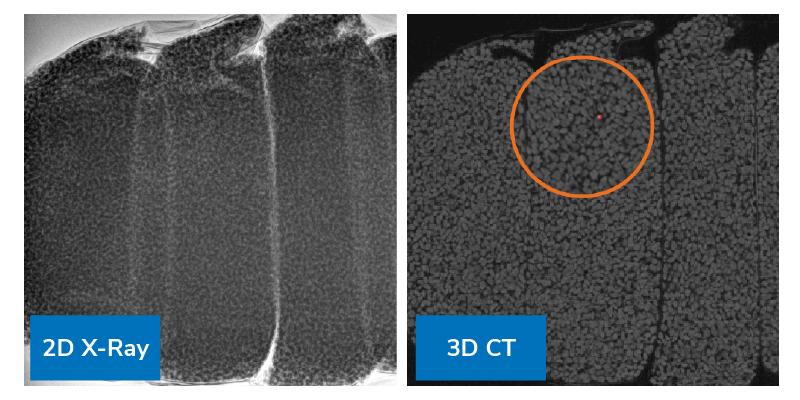
Example #3: Pet Food Kibble
Why It’s Difficult with 2D X-Ray:
Air pockets and density variation present challenges
How CT Helps:
Improves the ability to detect aluminum fragments while managing reject sensitivity in products that may naturally contain bone
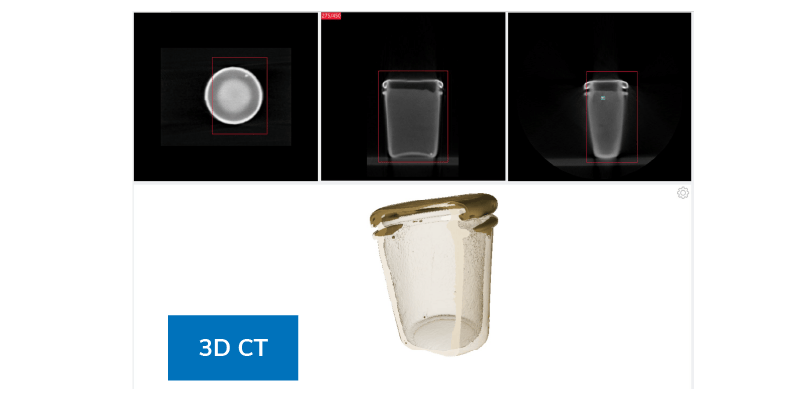
Example #4: Glass-in-Glass
Why It’s Difficult with 2D X-Ray:
Multiple units create visibility issues
How CT Helps:
Instead of separating individual units, algorithms can segment container structures and focus inspection within the product zone
CT inspection can even extend beyond foreign material detection. In certain applications, it supports qualitative inspection—such as evaluating ingredient distribution in ice cream or identifying surface defects in premium products. That’s where it becomes more than just a contamination response tool.
It’s 3D CT and 2D X-Ray: Not Either/Or
Traditional in-line inspection remains foundational in food safety programs. It’s well integrated into production environments and remains a strong first line of defense.
CT inspection isn’t designed to replace that. It’s designed to enhance it, especially in scenarios where product and foreign material complexity increase uncertainty.
CT may be particularly worth considering when:
- A known foreign material event has occurred
- Product layering limits confidence in detection
- You’re validating detectability of specific materials
- A hold-and-release decision requires stronger data
- Internal reinspection would rely on the same inline unit
Slowing down an inline X-ray can help in some cases. But the imaging method itself doesn’t change. CT offers a different architecture entirely, along with adjustable imaging parameters and more flexible algorithm tuning.
For QA managers, that distinction can matter when brand protection and release decisions are on the line.
How CT Inspection Affects Risk and Release Decisions
When evaluating CT inspection, the conversation usually centers on risk. During a foreign material event, the goals are straightforward:
- Define the affected range
- Isolate risk
- Release safe product with confidence
- Protect the brand
If CT inspection allows you to narrow a hold range, reduce uncertainty, or avoid unnecessary disposal of good product, that has measurable value. It also provides stronger data when responding to regulatory or customer scrutiny.
For QA and food safety teams balancing operational pressure with compliance expectations, having access to deeper inspection capability can make those decisions clearer.
When Should You Consider External CT Inspection?
You don’t need CT for every product or every scenario.
But it may be worth consideration for your re-inspection needs if:
- You’re dealing with layered or non-homogenous products
- Low-density contaminants are a concern
- You need to validate true detectability
- A hold-and-release situation requires deeper analysis
- You want more confidence in your physical contamination response
As CT inspection in food safety becomes more accessible, it gives QA teams another tool to strengthen physical contamination detection strategies.
If you’d like to learn more about how CT inspection works—including technical imaging details and real-world case examples—you can explore our full CT inspection webinar here. And if you’re evaluating CT inspection for a specific product or current event, we’re always open to reviewing the details with you.
Because when complexity increases, clarity matters.
Explore Your Foreign Material Inspection Options

Kye Luker serves as the Chief Product Officer at FlexXray, where he leads the development of innovative X-ray and CT inspection processes and technology. With over two decades of experience in the service, CPG, food, and beverage industries, Kye brings a wealth of knowledge in continuous improvement, quality assurance, and formulations to his role.