The Rework Loop
Why In-House Reinspection Falls Short for Foreign Material Contamination Resolution
Executive Summary
When a foreign material detection signal halts production, the next steps determine how quickly and confidently your product can return to commerce—and how well you prevent recurrence.
Food safety leaders often face the same challenge: how to manage on-hold product without compromising safety, traceability, or production efficiency. Traditional in-line detection systems are designed to monitor production, not to recover product once potential contamination has occurred. Thinking of internal re-inspection with in-line equipment as a default strategy can give a false sense of security and control—which often contributes to recurring problems down the line.
In this guide, we’ll explore:
- What the “Rework Loop” is, and how it contributes to potential recurring foreign material contamination issues
- The value-add capabilities of inspecting for foreign material using a third party
- How third-party inspection can help producers save resources and increase confidence in your food safety disposition
The Rework Loop: Doing the Same Thing and Expecting a Different Result
Internal rework often becomes an institutional habit rather than a solution. A single contamination event triggers the same series of steps:
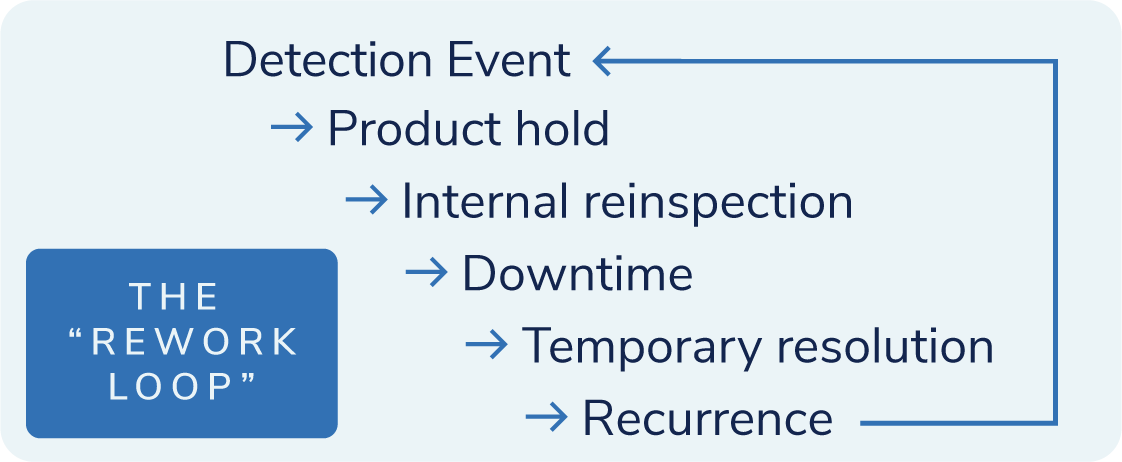
This “Rework Loop” restores operations but rarely prevents the next contamination event. Why?
- In-line detection equipment is meant to be a signaling tool, not an investigation tool. Reinspecting with the same system that may have missed an initial contaminant rarely provides more detailed data.
- Using operations teams for quality or food safety work is not their core competency.
- When inspection data isn’t captured in a robust way for CAPA or predictive maintenance, learning opportunities are lost, perpetuating the cycle.
A Real-World Scenario
Mid-production, a metal detector rejects product. Your investigation reveals a failing grinder blade shedding fragments. The team brackets one hour of product (roughly 100,000 pounds) for further analysis.
Options:
1. Reinspect the product using the same in-line detection system
2. Disposal of the potentially contaminated lot
3. Third-party inspection and recovery
Why internal rework often fails:
- Same equipment that missed the contaminant initially
- Minor sensitivity changes can trigger false positives
- High downtime with limited certainty of complete contaminant removal
This is where the “Rework Loop” begins. Production is paused for reinspection, costs begin to add up, and a temporary resolution prevents in-depth root cause analysis.
Thinking Beyond the “Hard” Costs of Internal Rework
When a contamination event triggers a product hold, the instinct to run it back through your own in-line detection equipment is understandable. It’s familiar, it’s immediate, and on the surface, it looks like the least expensive option. But the full cost of internal rework is rarely captured in that initial calculation.
The costs associated with reworking contaminated product internally fall into three categories: hard costs, opportunity costs, and downstream impacts.
Hard Costs
The most visible costs are the direct ones: labor hours diverted from standard production, storage costs for product sitting on hold while your team works through it, and the risk of customer SLA penalties if a delay in resolution pushes you past delivery commitments. These costs are measurable, but they’re often underestimated because they’re distributed across departments—labor shows up on one budget line, storage on another, and penalties may not surface until weeks later. And unless you’re working cross-functionally, these may not even be quantified in your decision making.
Opportunity Costs
Running contaminated product through your own lines means those lines aren’t running anything else. Production downtime during an inspection event is rarely accounted for in the initial disposition decision, but it compounds quickly—particularly for facilities operating near capacity. The question isn’t just what the rework costs, but what it costs to stop doing everything else while the rework is in progress.
Downstream Impacts
The costs that receive the least attention at the point of decision are often the ones with the greatest potential consequence. If internal rework misses contaminated product, your risk exposure grows substantially. Customer relationships erode when problems reach them rather than being resolved before distribution. The possibility of a recall introduces costs that dwarf anything on the rework ledger. And the reputational damage from a market-level contamination event is difficult to quantify and harder still to recover from.
These aren’t theoretical risks. They’re the downstream consequences of a decision that looked economical at the time.
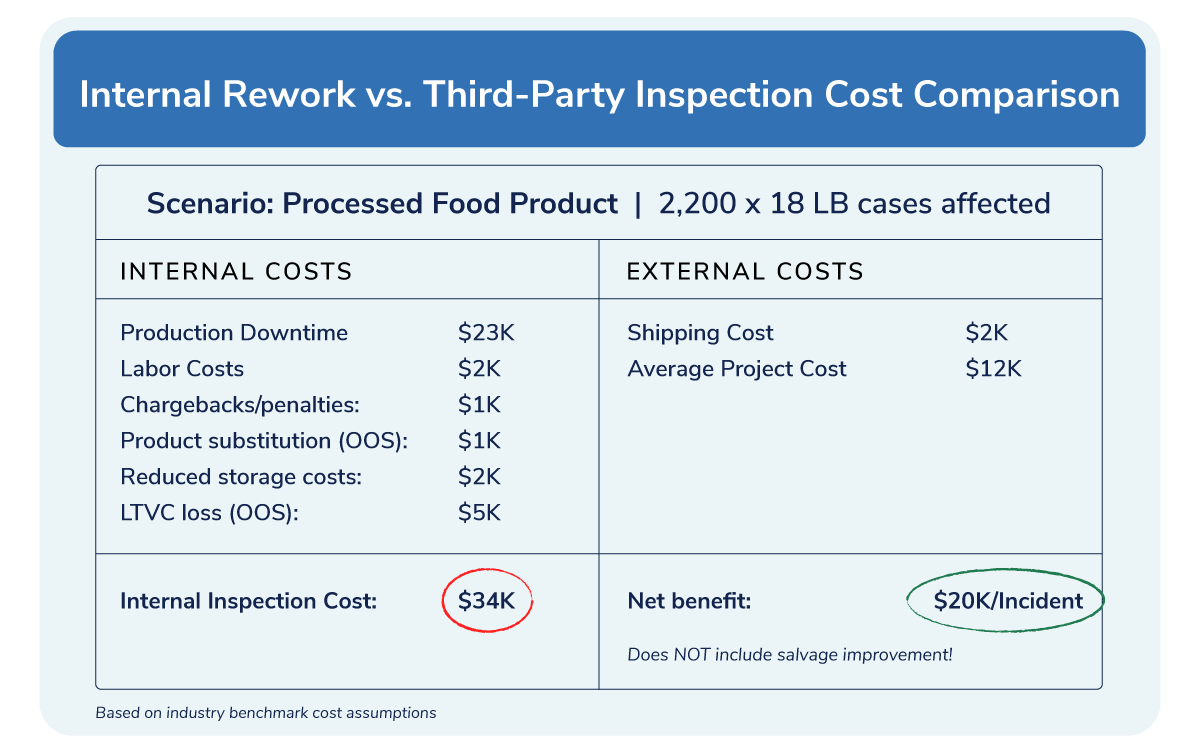
The cost comparison above uses conservative, industry-standard inputs to model a single contamination incident. The picture it produces is consistent across scenarios: internal reinspection carries costs that third-party inspection does not, and the gap is wider than most facilities expect when they make the decision.
The internal cost drivers—production downtime, reinspection labor, extended storage, retailer chargebacks, out-of-stock exposure, and potential customer loss to substitutes—are not hypothetical risks. They are the predictable, measurable consequences of pulling in-house resources into an unplanned inspection event. Individually, each line item is manageable. Together, across a single incident, they add up.
Third-party inspection introduces its own logistics costs—shipping, pallet moves, customer labor, and coordination. Those are real costs, and this model doesn’t minimize them. But they are bounded, predictable, and offset by what doesn’t happen: production doesn’t stop, QA teams stay on their primary work, and the inspection is performed by equipment and personnel dedicated to finding foreign material rather than adapted for it.
The net impact across the cost drivers shown here is in favor of third-party inspection. And that figure reflects one incident. For facilities that encounter foreign material events multiple times per year, the cumulative difference in cost is meaningful.
The Certainty Problem
Cost is one dimension of the internal rework decision. Confidence in the outcome is another—and it’s the one that’s harder to put a number on.
Internal reinspection tends to surface three structural limitations that cost accounting alone doesn’t capture.
First, the tooling: in-line detection equipment is designed and calibrated for production speeds, not for the forensic work of resolving a foreign material contamination hold. Applying it to a reinspection task it wasn’t configured for introduces uncertainty into the result from the start.
Second, operations teams conducting reinspection are rarely trained specifically in foreign material inspection process and documentation. The work gets done, but the rigor behind it may not meet the standard required for supplier investigations, CAPA documentation, or audit defense.
Third, when results are ambiguous or the process isn’t well-documented, traceability and future event prevention suffers. An inconclusive reinspection doesn’t just leave the contamination question open—it means you don’t have the data needed to do proper root cause analysis and corrective action planning.
The cumulative effect is a decision made with less confidence than the situation warrants. When the right tool isn’t used for the job, the risk of an incorrect disposition—clearing product that shouldn’t be cleared, or holding product unnecessarily—increases. Neither outcome is without consequence.
The External Edge: How Third-Party Inspection Helps Break the Rework Loop
Third-party inspection is more than a remediation tool. It’s a system reset. Leveraging a dedicated inspection service takes the uncertainty out of foreign material contamination response and can provide more confidence to help make a sound food safety disposition decision.
The primary difference between using in-line detection systems versus an external inspection service lies in the purpose-built technology they use for inspections. Modern inspection providers use:
- Medical-grade X-ray and CT imaging to detect even low-density contaminants, such as rubber and some plastics
- Slower speeds for increased granularity and image quality
- Tailored configuration for each individual product and foreign material combination
This approach restores operational confidence and turns a one-off incident into actionable insight, rather than a repeated disruption. By introducing an independent inspection step, you break the rework loop, reclaim safe product, and capture data that helps you improve your operations and prevent future incidents.
By introducing an independent inspection step, you break the rework loop, reclaim safe product, and capture data that prevents future incidents.
Why Third-Party Capabilities Matter
FlexXray’s inspection systems operate beyond the limits of traditional in-line detection. Our advanced imaging technology delivers higher resolution, lower detection thresholds, and real-time human verification. This combination bridges the gap between signal and certainty—transforming unknowns into actionable data.
That capability difference means:
- More contaminants found, including low-density materials like plastic, bone, and rubber
- Verified, traceable results suitable for supplier or QA documentation
- Faster return to production without compromising food safety
- Fewer product losses and stronger sustainability outcomes
When contamination events occur, capability—not cost—is the true differentiator.
Conclusions
Rework is a symptom, not a strategy. Internal reinspection or disposal can feel like control—but only independent inspection ensures complete visibility, product recovery, and prevention of future events.
FlexXray partners with manufacturers to:
- Recover safe product quickly
- Capture actionable data for CAPA and predictive maintenance
- Reduce waste and improve sustainability
- Provide peace of mind across supply chains
The best time to prepare is before a contamination event occurs. With FlexXray, your response is swift, precise, and fully supported, turning signals into solutions.
5 Capabilities to Look for in an Inspection Partner
- Speed: Fast turnaround—often within hours—to minimize downtime.
- Detection Power: Medical-grade X-ray technology with enhanced sensitivity for all contaminant types.
- Integrated Services: Sorting, re-bundling, reporting, and temperature-controlled environments.
- Proven Expertise: Documented performance across diverse food products and contamination scenarios.
- Regulatory Assurance: USDA- and FDA-registered facilities following Good Manufacturing Practices.
About FlexXray
FlexXray is North America’s leading provider of foreign material inspection and recovery services for the food industry. Using proprietary X-ray systems and a team of specialized technicians, FlexXray helps manufacturers quickly locate and remove contaminants while preserving safe product, protecting their brand, and maintaining supply continuity. With facilities across the U.S.—and now Europe through FlexXray France—we deliver fast, validated, and confidential inspection services designed for the speed and complexity of modern food production.