Common Types of Foreign Material in Food – Staging
Foreign material contamination is categorized by material type — some of the most common being metal, rubber, glass, bone, plastic, stone — because what the contaminant is determines almost everything that follows: where it likely came from, how detectable it is by modern in-line equipment, and what the response to a potential foreign material event looks like.
Each material presents its own sources and its own detection profile, and those differences matter when a facility is trying to understand the scope of a product hold or trace a contaminant back to its origin.
How does the industry define foreign material contamination?
Find Out Here
The Most Frequently Encountered Foreign Material Contaminants
Across FlexXray’s inspection work, six material types account for the overwhelming majority of foreign material findings: metal, glass, bone, plastic, stone, and rubber. They all vary in density and detectability, and each originate from different places in the production environment.

Metal
The most frequently identified foreign material contaminant in food manufacturing — and also the most detectable. Non-ferrous metals and small fragments are the exception, routinely escaping standard in-line systems, such as X-ray and metal detectors.

Glass
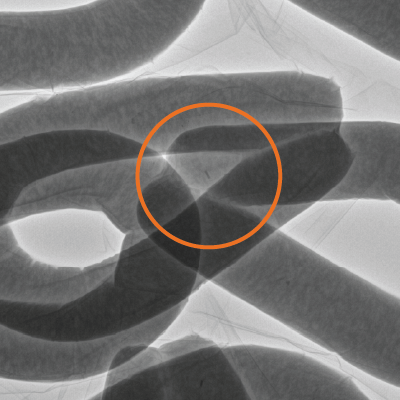
Most commonly originates from packaging breakage or glass-in-glass contact in jarred and bottled products. Detection varies significantly by glass type.
Bone & Organic Material
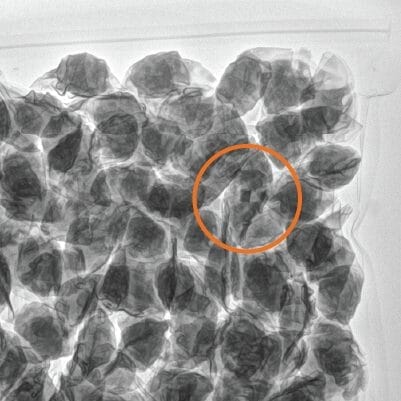
In boneless protein products, bone can be an unintended contaminant. It’s also one of the more difficult materials to detect because its density profile is close to the product surrounding it.
Plastic
Plastic enters the production environment through tools, utensils, packaging, and equipment components. Its low density makes it one of the hardest materials to catch with standard detection systems, often being nearly invisible.

Stone & Minerals
Largely agricultural in origin, arriving in raw ingredients like grains, legumes, produce, and spices. Detectability depends on mineral density and the product it’s found in.

Rubber
Gaskets, O-rings, seals, and conveyor components are the primary sources of rubber contamination. Rubber’s low density makes it one of the more challenging foreign materials for standard detection systems to catch consistently.
Learn more about the sources & causes of foreign material contamination here →
Why Material Type Matters for Detection
Different materials require different detection approaches — and no single method is built to catch everything. Metal is the most reliably detected foreign material under standard in-line systems, but glass, bone, and low-density plastics each present scenarios where those systems fall short. Understanding the detection profile of a specific contaminant type is often what determines whether X-ray, CT, or other methods are the right approach.
FAQs
Metal, glass, bone, plastic, rubber, and stone are some of the foreign material types most frequently identified in food manufacturing. Each has a distinct detection profile and originates from different sources in the production environment.
Metal is typically the most frequently identified foreign material contaminant across food manufacturing operations. It’s also generally the most detectable — though non-ferrous metals and small fragments are scenarios where standard in-line detection regularly falls short.
Plastic’s low density makes it difficult for standard detection systems to distinguish from many food products. Metal detection systems aren’t designed to catch it at all, and X-ray performance on plastic depends heavily on the density contrast between the contaminant and the surrounding product matrix.
Bone and other organic materials are technically not classified as “foreign” material under USDA guidelines, but for FlexXray’s purposes, we treat it as such. Unless a product is specifically sold as bone-in, consumers do not expect bone fragments in product. Given that this category of contaminant is both found in abundance by our teams, nearly always shows up in high-value animal protein or animal protein-inclusive products, and would certainly be considered “foreign” by consumers buying products advertised as boneless, we stand by this categorization.
X-ray inspection is effective across a wide range of foreign material types, with performance varying by contaminant density, size, and the product matrix it’s found in. CT scanning is available for cases where standard X-ray reaches its detection limits.