Foreign material contamination (FMC) continues to challenge food producers, even as detection technology advances rapidly. The 2025 FlexXray Benchmark Report reveals a critical insight: while in-line detection systems are increasingly sophisticated, gaps in team training and operational understanding limit their effectiveness. Technology alone cannot prevent contamination; human insight, applied consistently and thoughtfully, remains a vital component of any robust FMC control program.
The Confidence Gap: When Technology Alone Isn’t Enough
Modern detection systems—X-ray, metal detection, inline sieves, and strainers—have transformed what producers can detect. They operate faster, more precisely, and with greater consistency than ever before. Yet the Benchmark Report shows that confidence in these systems is far from universal. Over 50% of producers report investigating after a single automated rejection, but only 19% are “very confident” that their systems catch every incident of foreign material.
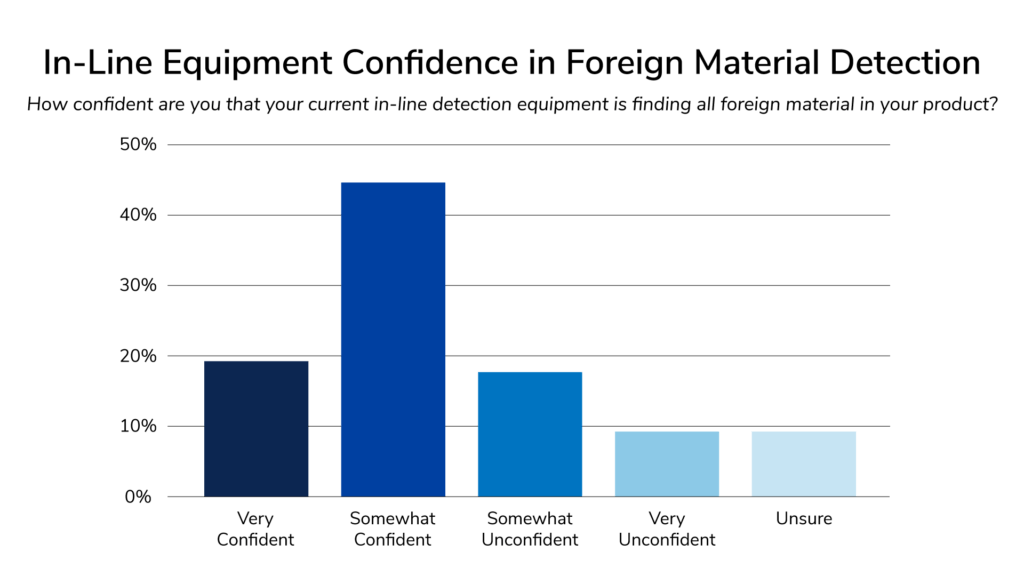
This gap underscores a simple truth: alerts are only useful if employees understand their context and implications. A system may flag a potential contaminant, but without a trained operator capable of interpreting that signal, the alert may be overlooked, mismanaged, or improperly escalated. In other words, technology can only amplify effectiveness when paired with informed, attentive teams.
Learn more about why automation can’t replace insight >>>
Why Employees Remain Central to FMC Prevention
The Benchmark data confirms that employees are still one of the most reliable detection tools. 45% of respondents identified staff as the strongest line of defense for catching foreign material. Yet most facilities provide formal FMC training just once per year. This infrequency leaves significant gaps, especially given turnover, promotions, and evolving production practices.
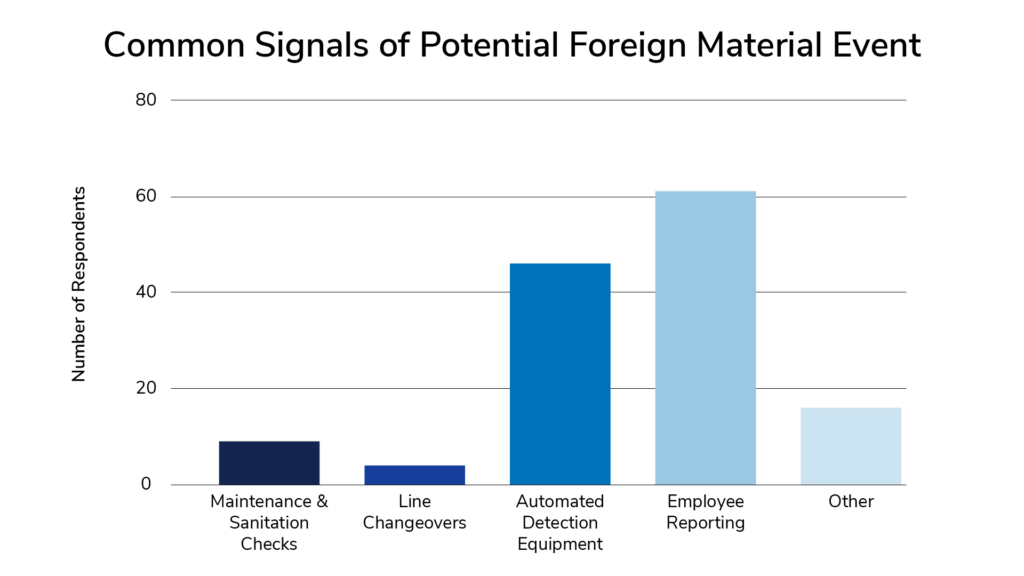
Employees’ ability to detect and respond to contamination hinges on more than rote knowledge. It requires contextual understanding: why a system reacts a certain way, how upstream ingredients or production processes can introduce risk, and what signs to watch for in packaging and equipment. Without this insight, even the best detection technology cannot reach its full potential.
Critical Areas Where Training Makes a Difference
The Benchmark Report highlights several areas where knowledge gaps most frequently compromise FMC control:
In-Line Detection Equipment —
Demands operators who understand both capabilities and limitations. Machines can only detect what they are configured to identify. Subtle changes in product size, density, or orientation can affect detection outcomes. Operators who recognize these nuances can identify off-schedule or unexpected contaminant events that might otherwise go unnoticed.
Production Equipment —
Can introduce foreign material itself. Breakage, wear, or improper maintenance creates risk. Employees must know what to watch for, from unexpected noises to worn parts or minor malfunctions that can produce contaminants before detection systems flag them. Awareness in this area can prevent small issues from escalating into major incidents.
Ingredient Streams and Supplier Inputs —
Contamination can originate long before a product enters the production line. Teams trained to evaluate incoming materials, monitor supplier compliance, and recognize patterns in rejects are better equipped to intervene upstream, reducing downstream risks.
Packaging Defects —
Misaligned materials, broken seals, and off-spec components can introduce foreign material. Employees who understand how packaging interacts with the product and production line can identify risks early, preventing the introduction of contaminants during line changeovers or sealing operations.
Handling, Rework, and Waste Management —
Often overlooked, but can be a significant source of contamination. Improper handling or storage of scrap, tools, or reworked product can reintroduce contaminants that detection technology may miss. Training staff in these areas creates an extra layer of defense.
Embedding Knowledge into Daily Operations
Effective training is not a once-a-year session. The most successful producers integrate learning into daily operations through practical reinforcement and continuous feedback. Recognition programs encourage employees to report potential contamination, while food safety scorecards and operational metrics provide insight into outcomes and trends. Floor-level practices, like designated storage for tools or scrap, reinforce good habits and reduce risk.
Training also emphasizes contextual understanding. Employees learn to anticipate how upstream changes—ingredient variability, equipment adjustments, or line speed fluctuations—can influence contamination risk. Over time, these practices cultivate a workforce capable of making informed, proactive decisions rather than reactive responses.
Bridging the Gap Between Technology and Human Insight

Even the most sophisticated detection systems are limited by configuration, throughput, and operational context. Technology operates as either a red flag, alerting teams to potential contaminants, or a spotlight, drawing attention to areas that merit closer inspection. FlexXray’s experience shows that teams who understand these distinctions, and how to respond, dramatically improve detection effectiveness.
For example, a detection system may flag a single anomaly that appears insignificant in isolation. A trained operator can interpret it in the context of recent production changes, ingredient batches, or packaging variations, identifying an upstream source before it escalates into a larger issue. Without this insight, a minor event may go unchecked, highlighting the limits of technology without human expertise.
The Payoff: Proactive FMC Prevention
Investing in training and understanding delivers measurable benefits. Teams with deeper knowledge can detect upstream issues earlier, make better use of detection technology, and prevent contamination from reaching finished product. Processes become more consistent, confidence in technology grows, and false negatives are reduced.
FlexXray partners with producers to bridge the gap between technology and human insight. Through guidance, contextual expertise, and hands-on support, FlexXray ensures that detection systems are applied correctly, employees understand risk, and operations are optimized to prevent and/or respond to foreign material incidents.
Want to strengthen your team’s ability to prevent and respond to foreign material contamination?